
Gnosis is not the same as Gnosticism.
Gnosticism was one historical attempt to describe a direct experience of the divine and to give language to a particular understanding of Christ Consciousness, but the moment such an experience is captured inside doctrine, mythology and fixed cosmology, something essential can easily become lost. Christ Consciousness, as I understand it, is fundamentally connected to sovereignty: the realization that divinity is not something that has to be sought outside of ourselves, nor something that requires continual submission to an external deity, priesthood, ritual system or metaphysical authority.
This is where many spiritual systems become complicated. They begin with the search for liberation and eventually create new structures of dependence. The Archons, the Demiurge, planetary rulers, Yaldabaoth and countless other figures can be understood literally, mythologically, psychologically or archetypally, but the essential question remains the same: where do you place your authority? The moment a person believes that their fundamental power is controlled by forces outside of themselves, they have already surrendered a part of their sovereignty.
For me, this is one of the deeper meanings behind the message of Yeshua. It was never simply about obedience or dependence. It was about remembrance. Know yourself. Become conscious of what moves through you. Recognize what you project outside of yourself. Take responsibility for the state of consciousness from which you experience reality. Gnosis begins when spiritual authority is no longer automatically handed over to something external.
This does not mean denying difficult forces, shadow, conflict or suffering. It means understanding the position from which you relate to them. A consciousness that constantly fights against what it fears can remain just as bound to that fear as someone who submits to it. Resistance can become another form of attachment. Whatever remains the central object of your attention continues to occupy psychological and energetic space.
A useful comparison is that of a radio receiver. Many different frequencies can move through the same space simultaneously, yet each receiver only reproduces the frequency to which it is tuned. One radio may produce static, another speech, another violent noise, while another receives a symphony. The existence of one frequency does not cancel the others. What changes is the tuning of the receiver.
Human consciousness functions in a remarkably similar way. Our nervous system, emotional history, beliefs, identity, attention and bodily patterns form part of the mechanism through which we interpret and respond to reality. If that inner system continually resonates with fear, powerlessness or conflict, those patterns will repeatedly become amplified in perception and behaviour. When the inner configuration changes, the field of resonance changes with it. The old frequencies may still exist, but they no longer automatically dominate the receiver.
This is why transformation cannot be reduced to fighting the external world. At some point the structure of the receiver itself has to change. That is where Gnosis becomes more than philosophy. It becomes embodied knowledge. It becomes the direct recognition of how consciousness organizes experience.
And this is precisely where Mara Palumbra begins.
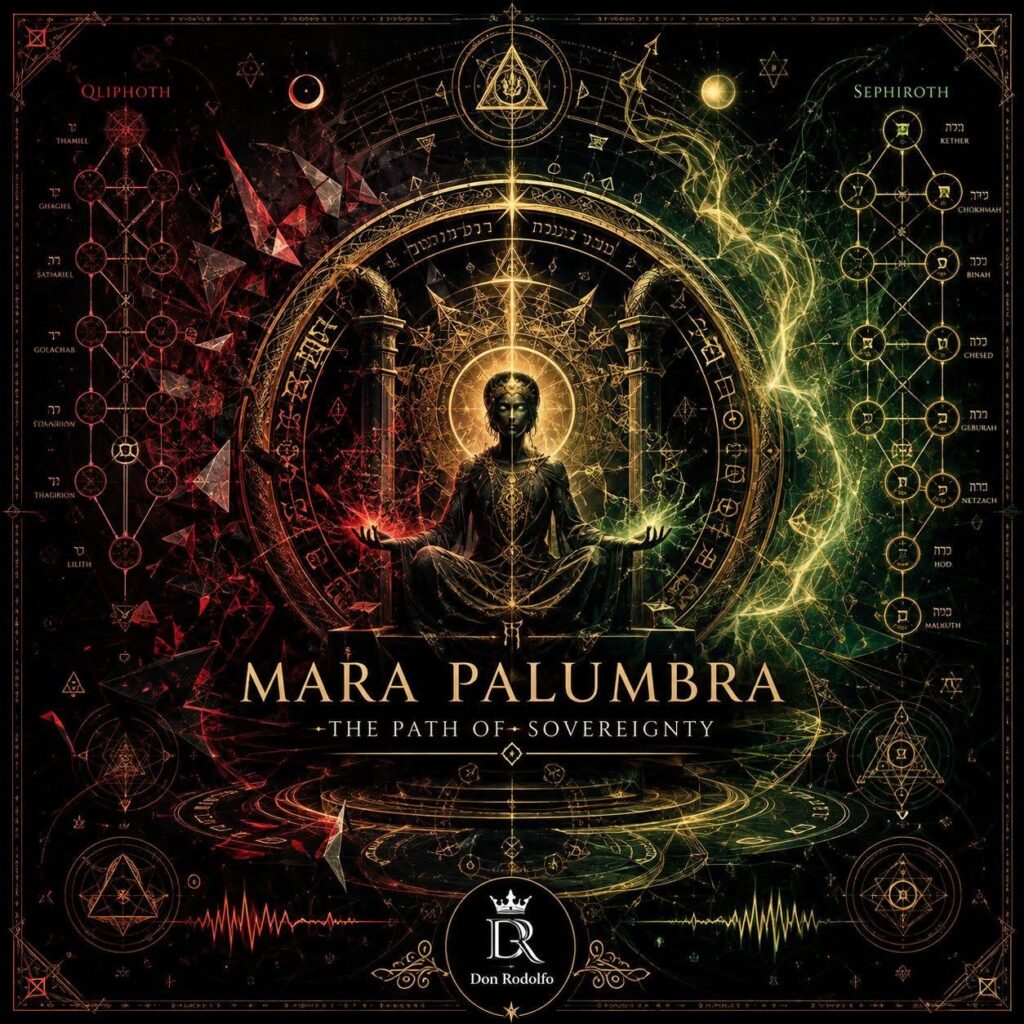
Mara Palumbra is not an attempt to replace one system of spiritual obedience with another. It is not submission to light, nor submission to darkness. It is not the worship of the Sephiroth or the fear of the Qliphoth. Its essence is the conscious integration and mastery of both currents.
Light and shadow are approached as dimensions of experience that must be understood, entered and integrated without surrendering sovereignty to either. Within Mara Palumbra we may work with rituals, symbols, archetypes, spiritual intelligences and ceremonial structures, but these are tools of transformation rather than objects of dependence. Their purpose is not to reduce the Palumbrista to obedience, but to reveal what remains unconscious, fragmented or projected.
The Palumbrista learns to enter the shadow without becoming consumed by it and to approach the light without losing individuality within it. Fear, desire, sexuality, death, power, love, will and consciousness are not treated as enemies that must be amputated from the psyche. They are forces that must be understood, carried and integrated.
This is also why both the Sephiroth and the Qliphoth exist within Mara Palumbra. Neither side, by itself, contains the totality of the human being. Wholeness emerges when we stop projecting rejected aspects of ourselves onto external heavens, hells, gods and demons and begin to recognize the deeper structures operating within consciousness itself.
Mara Palumbra is therefore not an escape from the world. It is a return to the center of one’s own authority. It is the movement from reaction into awareness, from dependency into responsibility, from inherited belief into direct experience and from fragmentation into integration.
That is what I understand by Gnosis. It is not belief. It is knowing through direct experience.
The essential question is no longer: “Who has power over me?”
The question becomes: “From what state of consciousness am I participating in the creation of my reality?”
That shift changes everything.
Sovereignty begins there.
Mastery begins there.
And Mara Palumbra begins there.